
I'm Begging You to Stop Saying 'Chic'
I have a bone to pick, or a dead horse to beat, if you will. I am thoroughly exhausted by our cultural obsession with the word “chic.” What began as a minor irritation has developed into a full-fledged grievance against the way our everyday vocabulary has surrendered to transient microtrends. And frankly, I have a few words to spare.
Over the past decade, our society has succumbed to a microtrend-driven lifestyle, with retail racks shifting from polka dots to chevron to plaid every few weeks. But isn’t this constant turnover precisely why so many of us have come to dread shopping? We hesitate to buy anything knowing that two months down the line, we’ll dislike it, because we only bought it after seeing it posted by every influencer on our feed. I can’t begin to tell you how many clothes I’ve bought that I adored at first, stashed them away for the right moment, and then discovered them three years later in the back of my closet with the tags still attached. In the end, I just gave them away after realizing I never actually liked the items; I just liked seeing other people wear them.
Apparently, our vocabulary is no less susceptible to the trend cycle than our closets. We preach individuality in fashion and champion the slow fashion movement yet rarely question why our language has become just as disposable.
I first noticed this shift when the word “demure” flooded our TikTok feeds and Instagram stories. After a single creator went viral using it, “demure” instantly transformed into a universal reference for anyone chronically online. Little by little, it infiltrated our daily conversations—starting perhaps as a joke, until I was hearing people use it on a daily basis. I was caught off guard and, honestly, a bit irritated. Practically overnight, a word once associated with modesty and restraint had been flattened into a viral catchphrase, tossed around alongside “mindful” and “cutesy.” I had even deleted TikTok, but apparently the algorithm had found a way to follow me into real life. Eventually, I developed a genuine resentment toward the word itself—a reaction I never anticipated having toward vocabulary (with the possible exception of “moist”). Then came “whimsical.” Though whimsy proved to be little more than a passing algorithmic phase, it paved the way for our current obsession with “chic.”
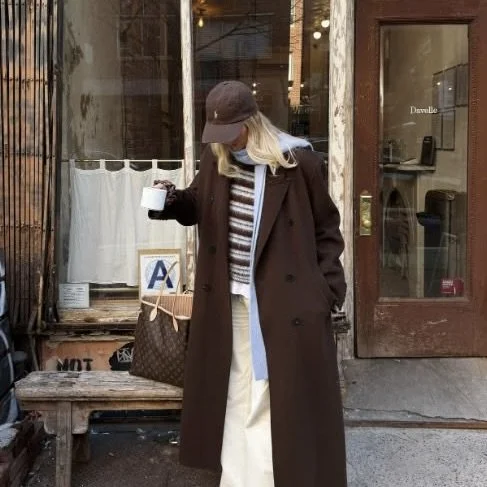
By definition, chic means “stylish, fashionable, and elegantly simple.” We’ve taken a word that is supposed to be timeless and turned it into a cheap trend. Wearing last night’s outfit and leftover makeup to breakfast the following morning is simply NOT chic, and while there is absolutely nothing wrong with doing so, it fails to meet the definition. Yet, social media feeds are continuously flooded with examples claiming everything under the sun is “chic,” even when those actions directly contradict what the word actually signifies. Of course, I understand the irony. Sometimes calling something “chic” is precisely the joke. But somewhere between the first clever use and the thousandth repetition, the irony wears thin. What began as an amusing contradiction becomes a linguistic reflex. Booking a last-minute flight to spend a single night in Ibiza without luggage isn't chic. It's spontaneous. Possibly irresponsible. Certainly expensive.
Why are we so eager to slap this label on everything? Has “chic” become an aesthetic scapegoat, a fashionable way to disguise our less-than-fashionable decisions? Perhaps it's easier to romanticize our chaos than to acknowledge it. When we rebrand our chaotic, disorganized, or uninspired choices as curated and intentional, we aren’t being fashionable; we’re just hiding behind a trendy shield. Although these inquiries center specifically on “chic,” they prompt a broader challenge: shouldn’t we strive to enrich our vocabulary and choose our words with precision?
There is a name for what happens when a word gradually loses the force of its original meaning: semantic bleaching. Through repeated use and increasingly broad applications, once-powerful words become diluted, stripped of the significance that once made them distinctive. Consider “iconic” or “literally,” two words whose meanings have been stretched to accommodate even the most trivial moments. Familiar expressions suffer a similar fate, becoming so predictable that they lose their figurative punch altogether. Case in point: I opened this essay with a bone to pick and a dead horse to beat. I'd bet half of you didn't even blink. Somewhere along the way, these expressions surrendered their emotional resonance and originality, reduced to little more than linguistic filler. This brings me to a phenomenon I have deemed “Fast-Fashion Linguistics.” We treat words like disposable tops, worn obsessively for three weeks because the algorithm mandated it, and then discarded into the landfill of cultural cringe once the novelty wears off. When everything is chic, nothing actually is.
If I can leave you with one piece of advice, it's this: strive to know. Question the words you use, why you use them, and whether they actually mean what you intend. I'll be the first to admit that I'll probably call something “chic” tomorrow and contradict this entire essay. Old habits die hard, and evidently, so do overused adjectives. But that doesn't mean we shouldn't try. Language should be curated, not mass-produced by an algorithmic feedback loop. We have an extraordinary vocabulary at our disposal. Why limit ourselves to whatever the internet has decided is fashionable this week?
In that spirit, allow me to introduce a word you may not know: philippic, a passionate, bitter speech or tirade directed against something. Consider this my personal philippic against lazy vocabulary. Let's bring back slow language. Because true style, whether hanging in your closet or coming out of your mouth, will never be found in a trending audio.